





The Evolution and Innovations Behind Electric Scooters
Complete e-scooter evolution: From 1895 Ogden Bolton patent to 2025 innovations—solid-state batteries, 95% charge in 50min, swappable batteries, IoT integration, dual 1104W motors, solar charging, and market growth to $320B by 2034.
Electric scooters represent over 130 years of technological evolution, transforming from experimental 1890s concepts into sophisticated 2025 urban mobility solutions featuring swappable batteries, IoT connectivity, and artificial intelligence. The journey from Ogden Bolton Jr.'s 1895 "electrical bicycle" patent to today's market—projected to reach $320 billion by 2034—reveals a fascinating story of innovation, perseverance, and convergence of multiple technologies. Understanding this evolution provides context for current capabilities and insight into the revolutionary changes arriving in the next generation of electric scooters.
Early Pioneers (1890s-1920s): The Foundational Era
The First Electric Personal Transportation Patents
1895: Ogden Bolton Jr.'s Electrical Bicycle
- Filed in Canton, Ohio, representing the first documented patent for electric personal transportation
- Utilized a 10-volt battery to power a hub-mounted motor
- Direct-drive system with no gearing—simple but functional design
- Limited commercial success due to battery technology constraints
1895: Hosea W. Libbey's Patent
- Filed November 8, 1895, in Boston
- Alternative electric bicycle design demonstrating simultaneous independent development
- Showcased early diversity of approaches to electric propulsion
1915: The Autoped—Establishing Modern Design Elements
While gas-powered rather than electric, the Autoped (manufactured 1915-1921) established critical design principles still used today:
- 10-inch wheels: Compact size for urban maneuverability
- Collapsing stem: Fold-down design for storage and portability
- Handlebar controls: Steering and throttle integration
- Standing platform: Space-efficient rider position
Manufacturing: Autoped Company (USA) produced units until 1921; Krupp manufactured licensed versions in Germany from 1919-1922.
Legacy: These design elements became standard features in modern electric scooters nearly 100 years later.
The Dormant Period (1920s-1960s): Waiting for Technology
From the 1920s through 1960s, electric scooter development largely stalled due to fundamental technological limitations:
- Battery Constraints: Lead-acid batteries were too heavy and provided insufficient energy density
- Motor Inefficiency: Electric motors lacked the power-to-weight ratios needed for practical vehicles
- Economic Factors: Cheap gasoline made internal combustion engines more economically viable
- Infrastructure: Limited electrical charging infrastructure
Mid-Century Breakthroughs (1960s-1990s): Foundation for Modern Electric Vehicles
1967: Critical Battery and Prototype Development
Karl Kordech's Fuel Cell Hybrid
- Austrian chemist and co-inventor of the alkaline battery
- Created fuel cell nickel-cadmium battery hybrid electric motorcycle
- Demonstrated viability of electric two-wheelers
- Pioneering work in battery chemistry that would later enable modern e-scooters
Floyd Clymer's "Papoose"
- Developed first electric bike prototype under the Indian motorcycle brand
- Floyd Clymer: famous racer and motorcycling pioneer (inducted into Motorcycle Hall of Fame, 1998)
- Demonstrated market interest in electric two-wheeled transportation
1991: The Lithium-Ion Revolution
The Breakthrough: Commercial lithium-ion batteries invented in 1991, revolutionizing electric vehicle technology.
Impact on Electric Scooters:
- Energy density 3-5x higher than previous battery technologies
- Significantly lighter weight per kWh
- Enabled practical electric scooters with reasonable range
- Rechargeable for hundreds of cycles
- Made compact, portable electric vehicles economically feasible
Significance: This single innovation made modern electric scooters possible. Without lithium-ion technology, today's e-scooter market wouldn't exist.
The Modern Era (1996-2016): Mass Production Begins
1996: Peugeot ScootÉlec—First Mass-Produced Electric Scooter
Specifications:
- First manufacturer to mass-produce electric scooters
- Nickel-cadmium (Ni-Cd) batteries (pre-lithium-ion adoption)
- Relatively heavy due to battery technology
- Limited range and charging time
Reception: Great commercial success despite weight and battery limitations; proved market demand existed for electric scooters.
Environmental Concern: Ni-Cd batteries weren't eco-friendly (toxic cadmium), limiting long-term viability.
1999: Razor Aluminum Kick Scooter—The Folding Format
While not electric, Razor revolutionized scooter design with their aluminum kick scooter, creating a global phenomenon:
- Lightweight aluminum construction
- Folding mechanism for portability
- Compact storage design
- Affordable mass-market pricing
Impact: Established the folding scooter format that became standard for electric versions. Razor later applied this design language to electric scooters, bridging kick scooters and modern e-scooters.
2000s: Electric Scooter Companies Emerge
ZAP (Zero Air Pollution) - Founded 1994
- Among the first companies to manufacture electric scooters
- Focused on environmental benefits and zero-emission transportation
- Limited commercial success in early years due to technology constraints
- Pioneered marketing electric vehicles to environmentally conscious consumers
2010s Transformation: The electric scooter industry truly took off in the 2010s as lithium-ion battery costs declined and performance improved dramatically.
The Sharing Economy Revolution (2011-2020): Mainstream Adoption
2011: Gogoro—Swappable Battery Innovation
Company: Taiwanese startup founded 2011
Revolutionary Innovation: Scooters powered by swappable battery system
Key Advantages:
- Eliminated charging wait time—swap batteries in seconds
- Battery swapping stations installed throughout Taiwan
- Centralized battery maintenance and management
- Always access to fully charged batteries
- Enabled long-distance travel without range anxiety
Impact: Gogoro transformed expectations for electric scooter convenience and proved swappable battery systems were viable at scale.
2025 Status: Gogoro's swappable battery model influenced current removable battery trends, with major manufacturers now offering detachable battery systems.
2017: Bird and Lime—Dockless Sharing Disrupts Urban Mobility
Bird - Founded 2017
- First widespread dockless electric scooter-sharing service
- Smartphone app-based unlocking and payment
- GPS tracking for scooter location
- Pay-per-minute rental model
- Rapidly expanded to major cities worldwide
Lime - Founded 2017
- Competitor to Bird, launched same year
- Similar dockless sharing model
- Quick expansion creating industry competition
- Drove innovation and price competition
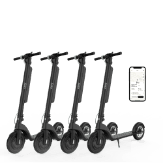
Mainstream Impact: The sharing economy model finally brought electric scooters into public consciousness. Suddenly, e-scooters appeared on street corners in major cities worldwide, introducing millions to electric micro-mobility.
Market Effect: Personal e-scooter sales increased dramatically as sharing users decided to purchase their own scooters for convenience and cost savings.
2025 Innovations: The Cutting Edge
The electric scooter market is projected to grow from $48.9 billion in 2025 to over $320 billion by 2034, driven by revolutionary technological advances.
Battery Technology Breakthroughs
Solid-State Batteries
Technology: Replace liquid electrolytes with solid compounds
Advantages:
- Safer—no risk of liquid electrolyte leakage or fire
- Lighter weight for same capacity
- Higher energy density (40-50% more than lithium-ion)
- Longer lifespan (2-3x cycle life)
Timeline: Toyota, BMW, and other major automakers investing heavily; expected to trickle down to e-scooters by 2025-2027.
Ultra-Fast Charging Technology
Ampace E30P Lithium-Ion Cells: Achieve 95% charge in under 50 minutes—dramatically reducing charging time from 3-5 hours to under 1 hour.
Impact: Makes e-scooters more practical for all-day use; charge during lunch break and ride all afternoon.
Graphene-Based Batteries (In Development)
Companies: Grabat, Samsung conducting promising research
Potential Benefits:
- Drastically reduced charging times (minutes instead of hours)
- Increased range (2-3x current capabilities)
- Lighter weight
- Better thermal management
Status: Still in development; commercial availability expected 2026-2028.
Lithium-Sulfur Batteries (Future Technology)
Developers: OXIS Energy and other research companies
Potential: Up to 5x the energy density of traditional lithium-ion batteries
Impact: Could extend e-scooter range to 200+ km (124+ miles) on single charge while reducing weight
Challenges: Shorter cycle life than lithium-ion; actively being addressed in research
Swappable/Removable Battery Revolution
Building on Gogoro's pioneering work, 2025 sees mainstream adoption of removable battery technology.
Key 2025 Models:
- Ola S1 Z Series: Dual removable 1.5 kWh batteries, 146 km range; deliveries began May 2025
- Honda Swappable Battery Scooter: Expected debut in 2025; Honda's entry into swappable battery market
- Vida V2 (Hero MotoCorp): Launched 2025 with removable batteries
- SPLACH Mukuta: Detachable battery design for convenient indoor charging
Advantages:
- Charge batteries indoors (apartment-friendly)
- Own multiple batteries for extended range
- Replace degraded batteries without replacing entire scooter
- Future battery technology upgrades possible
Motor Performance Advances
Dual-Motor Systems Become Standard (Performance Models)
- SPLACH Mukuta: Two 1104W motors (2208W total), 45 km/h top speed in 4 seconds
- Ola S1 Z: 0-20 km/h in 1.8 seconds; 0-40 km/h in 4.7 seconds; 70 km/h top speed
- Kaabo King GTR: Dual 2000W motors, 13,440W peak output (covered in speed article)
Efficiency Improvements: Modern brushless DC motors achieve 90-95% efficiency (vs. 75-80% for older brushed motors).
Solar Integration
Innovation: Flexible, lightweight solar cells embedded into decks or handlebars
Capabilities:
- Trickle charging while parked outdoors during daytime
- Add 5-15% range per day in sunny conditions
- Reduce dependence on grid charging
- Sustainable energy source
Limitations: Not sufficient for full charging but useful for range extension
IoT and Smart Features
2025 Standard Features:
- GPS Tracking: Locate scooter via smartphone app; theft recovery assistance
- App-Controlled Locks: Immobilize scooter remotely if moved without permission
- NFC Card Unlocking: Tap-to-unlock systems (alternative to smartphone)
- Remote Diagnostics: Scooter reports maintenance needs via app
- Performance Insights: Track speed, distance, battery health, riding patterns
- Firmware Updates: Over-the-air updates for motor controllers and features
- Geofencing: Speed limiters activate automatically in designated zones
Advanced Safety Features
Anti-Lock Braking Systems (ABS)
- Prevents wheel lock-up during hard braking
- Particularly useful in wet or slippery conditions
- Expected to become standard on premium models by 2025-2026
- Already present in high-end electric cars and motorcycles
Collision Detection and Avoidance Systems
Technology: Sensors and cameras detect obstacles
Functionality:
- Automatic braking if collision imminent
- Similar to Tesla and other electric vehicles
- Forward-facing radar or camera systems
- Audible warnings before automatic braking
Timeline: Expect initial implementations on ultra-premium models (2025-2026), broader adoption by 2027-2028.
Market Evolution and Growth Projections
Market Size Trajectory
- 2025: $48.9 billion global market
- 2034 (Projected): Over $320 billion
- Growth Rate: Approximately 23% compound annual growth rate (CAGR)
Key Market Drivers
- Urban congestion driving demand for compact transportation
- Environmental awareness and sustainability goals
- Last-mile connectivity solutions
- Improving battery technology reducing costs and increasing range
- Government incentives for electric vehicle adoption
- Expanding charging infrastructure
Regulatory Evolution and Challenges
2025 Regulatory Landscape: 28 states and Washington D.C. have updated e-scooter laws addressing age restrictions, speed limits, and designated riding areas.
Recent Examples:
- New York City: 15 mph speed limit (October 2025) following 623 e-scooter collisions in 2025
- Perth, Australia: E-scooter trial suspended June 2025 after pedestrian death
- Proposed Legislation: NYC's "Priscilla's Law" may require registration and license plates
Conclusion: From Experimental Concept to Essential Mobility
The evolution of electric scooters spans 130 years—from Ogden Bolton Jr.'s 1895 electrical bicycle patent to today's sophisticated machines featuring swappable batteries that charge to 95% in 50 minutes, dual 2000W+ motors delivering motorcycle-level acceleration, IoT connectivity with GPS tracking and remote diagnostics, and artificial intelligence-powered collision detection systems.
Key technological milestones enabled this transformation: the 1991 lithium-ion battery breakthrough made practical e-scooters possible; Gogoro's 2011 swappable battery system solved charging convenience; and Bird/Lime's 2017 sharing model brought e-scooters into mainstream consciousness. Now, 2025 innovations—solid-state batteries offering 40-50% higher energy density, graphene battery research promising minutes-long charging, lithium-sulfur technology with 5x energy density, and solar integration for sustainable charging—position electric scooters for explosive growth from $48.9 billion today to $320 billion by 2034.
The companies and inventors who pioneered this technology—from early visionaries like Ogden Bolton Jr. and Floyd Clymer to modern innovators at Gogoro, Bird, Lime, and countless battery researchers—have collectively created a transportation revolution. As e-scooters continue evolving with ABS braking, collision avoidance, and AI integration, they're becoming not just alternatives to cars but essential components of sustainable urban mobility ecosystems. The question is no longer "Who made electric scooters?" but rather "What revolutionary capabilities will the next generation bring?" The answer, judging by current innovation trajectories, is extraordinary.